

I am not an AI scientist, a technology billionaire, or a policymaker. I am simply someone watching this transformation from a part of the world where access to every new capability is neither immediate nor equal. And from here, the AI revolution looks slightly different.
My concern is not that artificial intelligence is advancing. Progress is inevitable, and AI has extraordinary potential to improve human life. My concern is that technology may now be advancing faster than humanity’s ability to absorb it — and certainly faster than all of humanity can access it equally.
Every few weeks another capability appears. Another platform becomes essential. Another message tells us that we must learn a new AI tool or risk being left behind. For people with money, infrastructure, education and early access, this can be exhilarating. For millions elsewhere, it can feel like watching the future being distributed unevenly.
The digital divide may therefore become something much greater: an intelligence-access divide.
And inequality is only part of what troubles me.
We increasingly celebrate our ability to obtain answers instantly. But thinking is not merely obtaining an answer. Human reasoning develops through uncertainty, mistakes, disagreement, patience, experience and the difficult process of connecting one idea with another.
If machines increasingly perform those processes for us, I worry that we may become excellent at asking, but progressively weaker at thinking.
AI pioneer Yoshua Bengio has argued that the acceleration of powerful AI systems is occurring faster than society, regulation and our institutions can adapt. He has specifically warned that societies need time to understand these systems and build safeguards around them.
Geoffrey Hinton, whose research helped create modern AI, has expressed a similar uncertainty. While acknowledging AI’s enormous potential, he has warned that humanity is entering territory it has never encountered before and that governments need regulation and serious research into its consequences.
Even outside the technology community, the concern is fundamentally human. Pope Francis told world leaders that human beings must preserve the ability to make meaningful decisions rather than surrendering that role to machines, arguing that human dignity itself requires a space for genuine human control.
These warnings matter to me not because famous people have said them, but because they reinforce something ordinary people can already feel.
We may be creating generations surrounded by extraordinary intelligence while giving them fewer reasons to develop their own depth of thought.
Human maturity has never come simply from possessing information. It comes from living: failing, questioning ourselves, understanding other people, changing our minds, discovering that many things we once chased were not as important as we imagined.
Many people only understand the “rat race” after spending years running in it.
What happens when future generations experience less of that intellectual and emotional struggle because technology constantly predicts, recommends, summarizes, decides and responds for them?
The danger is not necessarily that people become less intelligent. It may be subtler: that we become less accustomed to thinking deeply, tolerating uncertainty and understanding perspectives beyond our own.
And that has social consequences.
A society with powerful tools but declining patience, reflection and empathy could become more polarized, not less. A generation constantly comparing itself with machine-assisted achievement, while simultaneously struggling to understand its own purpose, could experience greater alienation, anxiety and depression.
None of this means we should stop AI.
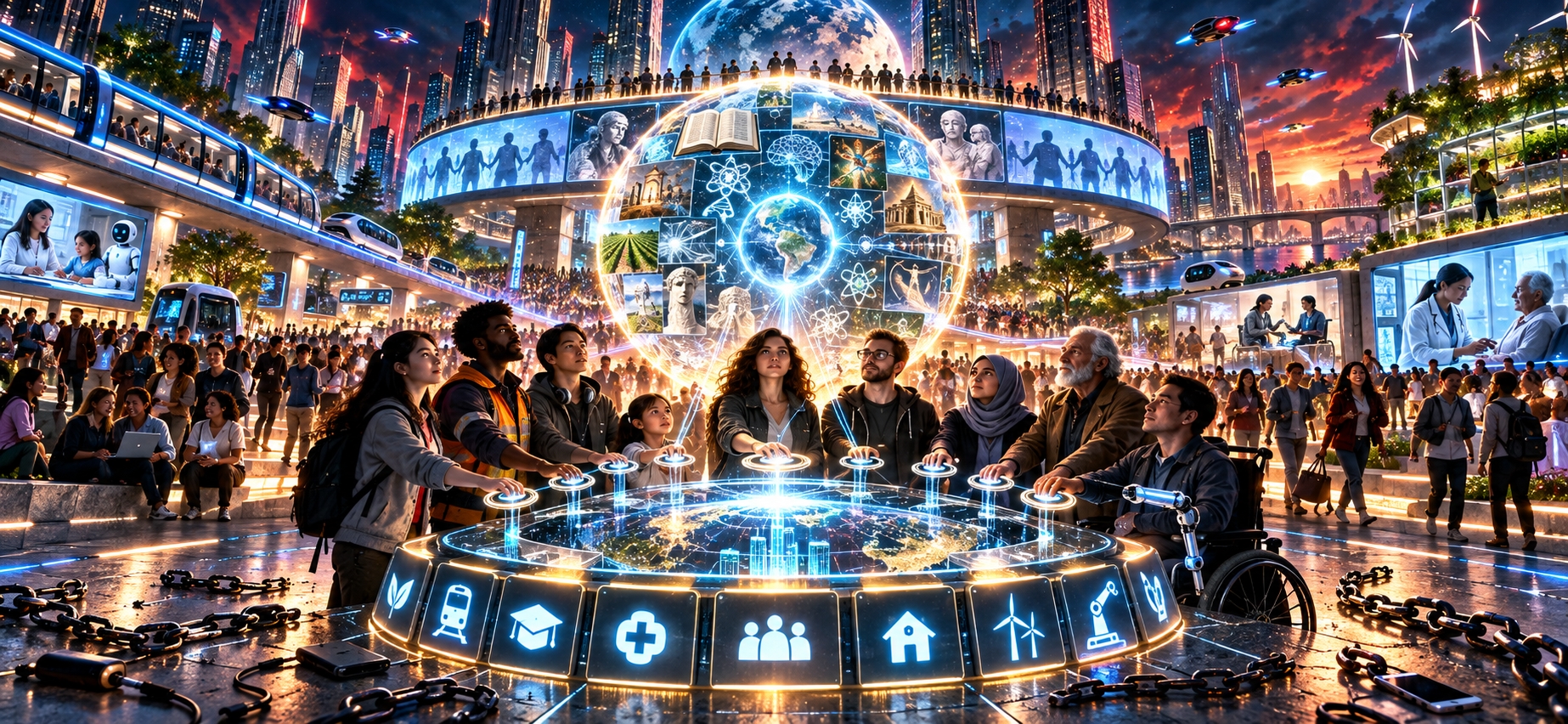
It means we should stop treating speed as the only definition of progress.
More than 30,000 people eventually signed the 2023 call for a temporary pause in the training of systems more powerful than GPT-4, including Elon Musk, Steve Wozniak, Yoshua Bengio, Stuart Russell and Yuval Noah Harari. Whatever one thinks of that particular proposal, the question behind it remains important: should technological capability advance simply because it can, or should society occasionally be allowed time to catch up?
For those of us outside the centres where these technologies are created, I would add another question:
Who is being given the opportunity to catch up?
AI should not become another force that divides humanity between those who own the future, those who can afford the future, and those desperately trying to keep pace with it.
Perhaps the most important challenge of artificial intelligence is therefore not teaching humans how to use AI.
It is ensuring that, while learning to live with artificial intelligence, we do not gradually surrender the very experiences that teach us how to be human.